

What Is Millimeter Wave Radar?
Understanding Its Physical Principles and Industry Trends in One Article
In recent years, millimeter-wave radar (mmWave radar) has rapidly become one of the most important sensing technologies across industries such as autonomous driving, robotics, smart homes, and vital sign monitoring. However, many people still associate it only with basic distance measurement, overlooking its deeper physical principles and disruptive potential.
This article provides a clear and structured explanation of what millimeter-wave radar is, how it works, what it can measure, and why it is shaping future industries.
[Image 1: Conceptual illustration of millimeter-wave radar sensing objects]

1. What Is Millimeter-Wave Radar?
In simple terms:
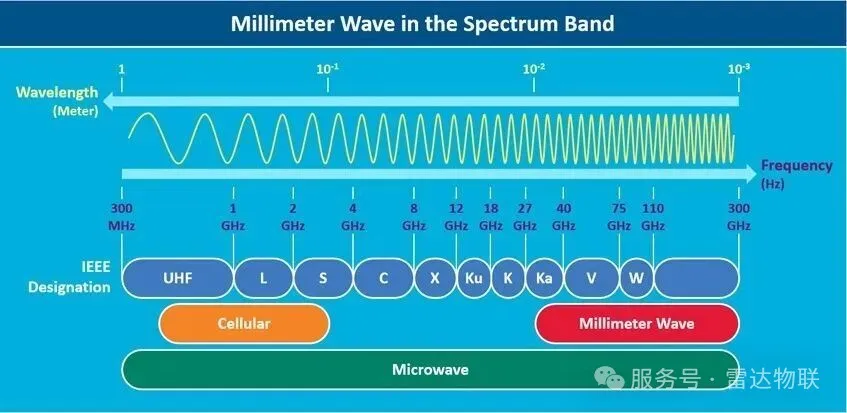
Millimeter-wave radar is a sensor that uses electromagnetic waves in the 30–300 GHz frequency range to measure a target’s distance, velocity, angle, and motion trajectory.
The radar transmits high-frequency electromagnetic waves. When these waves encounter an object, they are reflected back as echoes. By analyzing frequency shifts and phase changes in the returned signals, the system extracts precise spatial and motion information.
Frequency and Wavelength Relationship
- A 77 GHz radar has a wavelength of approximately 3.9 mm, which is why it is called millimeter-wave
- Higher frequency → shorter wavelength → higher resolution
[Image 2: Frequency vs. wavelength comparison chart]
2. Why Is Millimeter-Wave Radar So Important?
Among all sensing technologies, millimeter-wave radar stands out due to three unique advantages.
① High Resolution and Precision
- Short wavelengths enable high spatial resolution
- Multi-antenna arrays and MIMO technology improve angular accuracy
- Enables centimeter-level distance measurement and millisecond-level velocity detection
② Stable Performance in Harsh Environments
- Unaffected by lighting conditions (works in darkness, glare, or backlight)
- Maintains performance in rain, fog, snow, and dust
- Ideal for outdoor and night-time applications such as autonomous driving and security
③ Deep Sensing Capability for Vital Signs
Millimeter-wave radar can detect micro-motions of the human chest, enabling:
- Respiration rate monitoring
- Heartbeat detection
- Fall detection and sleep monitoring
This has become one of the most promising commercial application areas.
3. How Does Millimeter-Wave Radar “See” Objects?
(Core Principle Explained in One Minute)
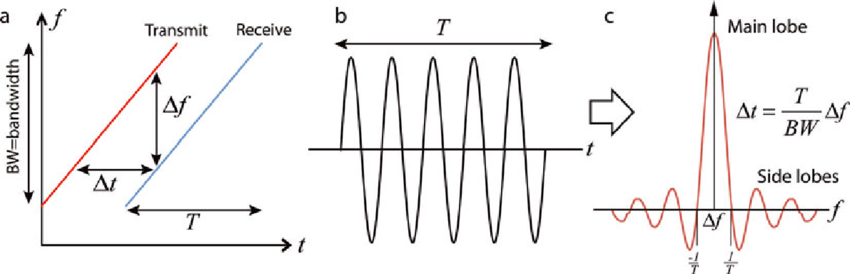
Most modern millimeter-wave radars use FMCW (Frequency-Modulated Continuous Wave) technology.
Basic process:
- Transmit a frequency-increasing chirp signal
- The signal reflects off the target and returns with a time delay
- Transmitted and received signals are mixed to generate a beat signal
- Beat frequency → distance information
- Phase changes across multiple chirps (Doppler FFT) → velocity information
[Image 3: FMCW signal transmission and beat frequency diagram]
4. What Can Millimeter-Wave Radar Measure?
| Information | Meaning | Technical Source |
|---|---|---|
| Range | How far is the target? | Beat frequency |
| Velocity | How fast is it moving? | Phase change across frames |
| Angle | Which direction is it in? | Antenna array phase difference |
| Trajectory | How does it move? | Multi-frame fusion & tracking |
These four capabilities form the foundation of millimeter-wave radar perception.
5. Typical Application Scenarios
① Autonomous Driving and ADAS
- Forward collision warning
- Adaptive cruise control
- Blind spot detection
- Parking assistance
- 77 GHz / 79 GHz radars are now standard automotive components.
② Human Vital Sign Monitoring
- Respiration and heartbeat detection
- Fall detection
- Healthcare, sleep monitoring, elderly care
③ Indoor Sensing and Smart Homes
- Human presence detection
- Motion and static target recognition
- Smart lighting and HVAC energy optimization
④ Industrial and Robotics Applications
- Indoor positioning
- AGV / AMR obstacle avoidance
- SLAM-assisted robotic perception
[Image 4: Application montage – automotive, healthcare, smart home, robotics]
 [Image 4: Application montage – automotive, healthcare, smart home, robotics]
6. Industry Trends: Why You Should Understand mmWave Radar Early
Over the next five years, millimeter-wave radar will experience explosive growth.
Intelligent Vehicles
- Radar count per vehicle increasing from 1–3 → 5–8 → 10+
- Higher angular resolution
- Full-scene perception coverage
Smart Home Market Expansion
Millimeter-wave presence detection is rapidly replacing cameras due to:
- No privacy concerns
- Higher positioning accuracy
- Easier consumer adoption
New Blue Ocean in Health Monitoring
Applications include:
- Bedside monitoring
- Infant and elderly care
- Micro-motion detection
Millimeter-wave radar is reshaping non-contact healthcare.
Rapid Growth in Education
Universities increasingly offer:
- Radar principles laboratories
- Intelligent sensing and robotics courses
- Electromagnetic wave and signal processing curricula
This drives strong demand for millimeter-wave radar teaching and experimental platforms.
7. Conclusion: Why Learn Millimeter-Wave Radar Today?
- Millimeter-wave radar is moving from specialized technology to mainstream adoption
- It is one of the most important sensing technologies of the next decade
- Offers high resolution, environmental robustness, low cost, and vital sign detection
- Industry and academia demand for mmWave radar engineers is rapidly increasing
Learning millimeter-wave radar today means mastering a core engineering skill for the future.